
Why are Utility Bills so High? A Guide to Understanding Your Bill
We know your utility bills are high and getting higher in New York State. In this guide we want to empower you to understand your bill, why bills keep going up, and provide some steps you can take to lower them.
In New York State, customers receive electricity and gas from several kinds of organizations. Some areas have municipally-owned utilities while others have investor-owned utilities. Municipally-owned utilities in New York are small, public utilities that are owned and operated by local governments. The majority of New Yorkers receive service from investor-owned utilities like National Grid, NYSEG and Central Hudson. These utilities are private companies regulated by the Public Service Commission. They provide essential electricity and gas service to their customers, but they also need to return a profit to their investors. In most places in New York state, consumers are not able to pick their utility provider.
What makes up an energy bill?
Your energy bills include electricity usage and heating fuel usage. In many areas of the Capital Region, National Grid may provide your electricity and gas bill. While there are several other ways to get your energy bills, including if you have propane, oil, or kerosene delivered to your home, we will focus on combined electricity and gas bills from utilities.
Understanding your bill
We provide a guide for some of the important pieces of information on your utility bill. Here we have an example of a National Grid bill. Each utility company has a different bill, but most provide similar information. If you have any questions and would like help understanding your bill, please reach out to the Capital Region Clean Energy Hub: https://www.cleanenergycapitalregion.org/contact.
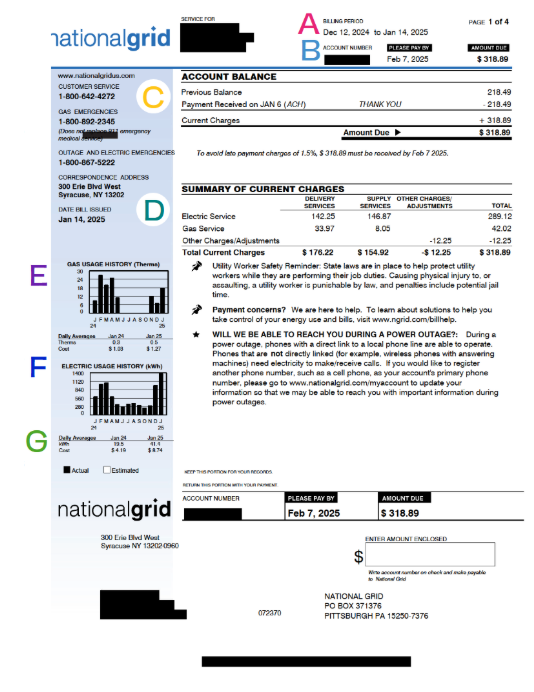
A. Billing period
B. Account number
C. Account balance
If you are on budget billing or a deferred payment agreement, this information will show here.
D. Summary of charges
E. Gas usage over time in Therms. Therms measure the amount of heat or energy. One therm equals 100,000 British Thermal Units (BTU).
F. Electric usage over time in kilowatt hours (kWh). Running your clothes dryer for 30 minutes uses 1 kWh.
G. Compare your average daily usage and cost with previous year. Note that the usage bars are black, indicating an actual reading was taken. If they are white, the reading was estimated and may be incorrect.
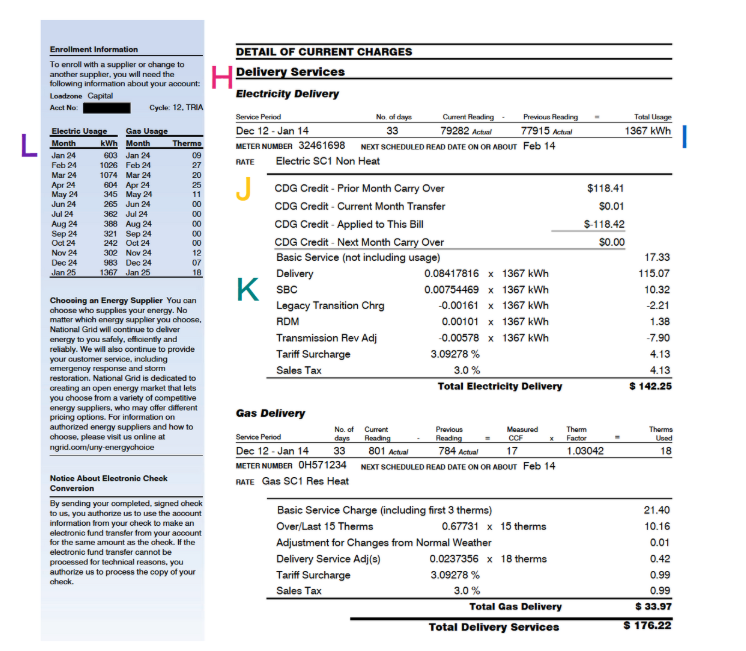
H. Delivery services is how much it costs for the electricity and gas to be delivered to your home. Utility companies set this rate in the Rate Case process (see pg 8 for more information).
I. Total usage. Do you have an actual or estimated reading? Check if your reading is an estimated reading. If so, it may be incorrect. This can be found near letter G.
J. Credits. You will see any credits you receive here. This may be community solar as seen on this bill with “CDG” or you may receive an energy affordability credit (EAP).
K. SBC stands for Systems Benefit Charge and funds programs like EmPower+. These are grant programs that you are already paying into.
L. Usage over time - check to see how much your usage is per month.
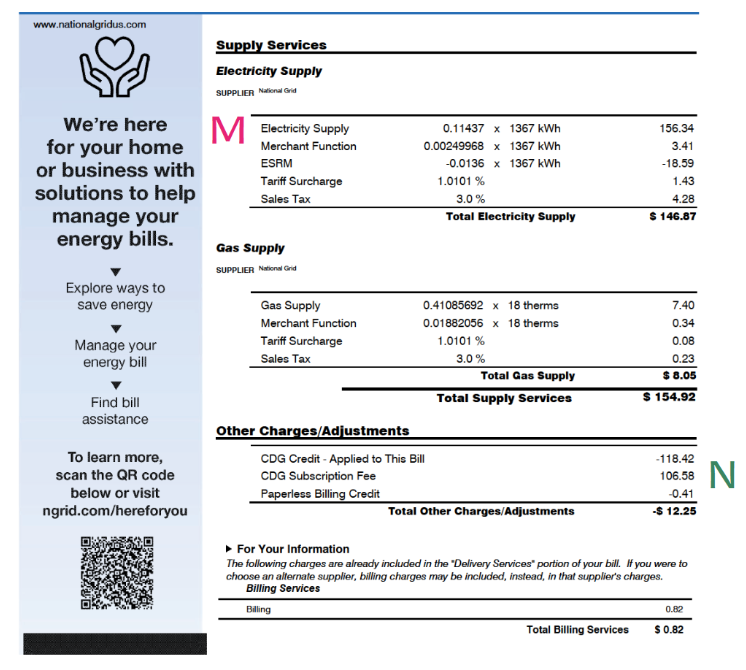
M. Supply Services. This is how much the utility pays for the electricity and gas that you use. Utilities do not control these prices. Instead, they depend on how much energy is being generated and used in the region at any time. For instance, during peak cooling moments on hot summer days, energy tends to be more expensive.
N. If you have a community solar subscription, this is where you can find the net discount applied to your bill.
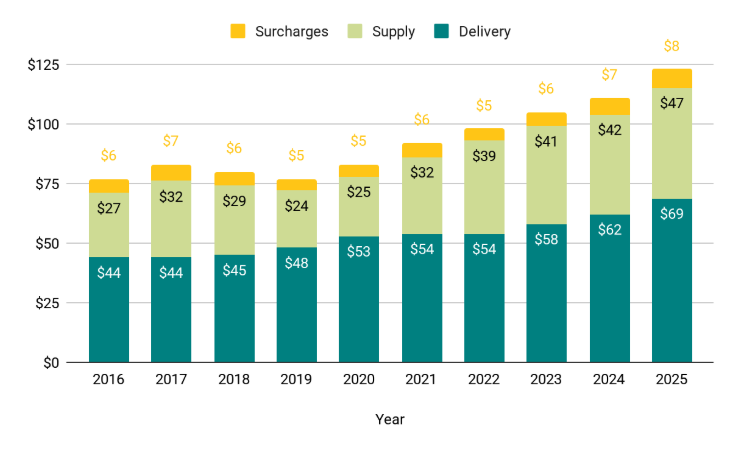
This chart shows the change in the cost of a bill for a National Grid customer who uses an average amount of electricity (625 kWh) per month. In this example, the overall cost of the bill has increased 60% between 2016 and 2025. Rates will continue to increase for the next two years.
Data from National Grid and DPS.
How are electricity prices determined?
The state determines the allowed rate increases in a process called a Rate Case. According to the Public Utility Law Project, a Rate Case is “a formal process used to determine the amounts to charge customers for electricity, natural gas, private water, and steam service provided by regulated utilities.” In other words, a rate case is how New York State determines how much a utility like National Grid, Central Hudson, and others are allowed to raise their rates for the next few years.
Utility providers set the delivery portion of the electricity and gas rate. The supply costs depend on the price of generating the electricity or the cost of natural gas and are not set by the utility provider. Utility rates fund labor, maintenance, and infrastructure costs to run the grid. A relatively small amount of the rate increases go to programs like energy efficiency and electrification programs and energy affordability programs. Other portions of the bill go to executive bonuses and miscellaneous expenses.
Why and how to get involved in a rate case?
Importantly, rate increases are cumulative, so every unchallenged rate hike raises the cost beyond what it was before. To date, every rate case brought to the Public Service Commission has led to increased rates. Individuals and organizations can participate in rate cases. One way to get involved is by leaving comments and attending public meetings on ongoing rate cases. Check out dps.ny.gov/pending-and-recent-electric-rate-cases to learn more.
Actions you can take now to reduce your bill
In winter, lock windows, shut storm windows tight, and install plastic securely over the window
Ensure heat registers and cold air returns aren’t blocked by furniture or other objects.
Lower the thermostat on your water heater to 120° F.
Clean refrigerator coils (behind or below the unit) and dryer lint traps regularly.
Unplug small kitchen appliances. These use energy if plugged into the wall, even when switched off.
Close doors, turn off lights, and lower the heat in rooms you are not using.
The Capital Region Clean Energy Hub can help you find programs to reduce costs
Energy advisors will help you navigate program eligibility and connect you with resources.
City of Albany, Columbia, Greene: Fiona | (518) 275-4814
Saratoga, Washington, Warren: Tyler | (518) 941-4041
Schenectady, Rensselaer, rural Albany: Alex | (518) 764-9022
HEAP: check if you are eligible for the Home Energy Assistance Programs (HEAP). Income limits may be higher than you think and increase each year.
Energy Affordability Program (EAP): EAP can provide a credit on your monthly bill if you are income qualified. Learn more about the program and learn how to enroll with your utility here Energy Affordability Program | Department of Public Service.
Get help weatherizing your home: There are two grant programs in our area. Apply for EmPower+ through NYSERDA and the Weatherization Assistance Program (WAP).
Switch to community solar: Community solar is a low-commitment way to save 10-20% on your bills and benefit from clean energy. To learn more about community solar click here.
Helpful Contacts
Get started by reaching out to an energy advisor!
The Capital Region Clean Energy Hub will help you navigate program eligibility and connect you with resources.
energy@ahphome.org
City of Albany, Columbia, Greene: Fiona | (518) 275-4814
Saratoga, Washington, Warren: Tyler | (518) 941-4041
Schenectady, Rensselaer, rural Albany: Alex | (518) 764-9022
Public Utility Law Project (PULP) provides legal assistance for utility shut-offs.
(877) 669-2572
info@utilityproject.org
National Grid Consumer Advocates can resolve issues with bills and assist in sign-ups for budget billing and payment plans.
Albany and Columbia: Kristie Alcindor
518-791-5621 | Kristie.Alcindor@nationalgrid.com
Schenectady, Schoharie, Otsego and Rensselaer: Anne O’Connell
Anne.OConnell@nationalgrid.com
Saratoga, Warren, Washington: Kari Kelly
Kari.Kelly@nationalgrid.com
Other Utility Contacts
NYSEG | (800) 572-1111 press 2 -> 4 -> 5 to speak with a representative
Central Hudson | (845) 452-2700
Department of Public Service can receive utility complaints and address some issues
(800) 342-3377